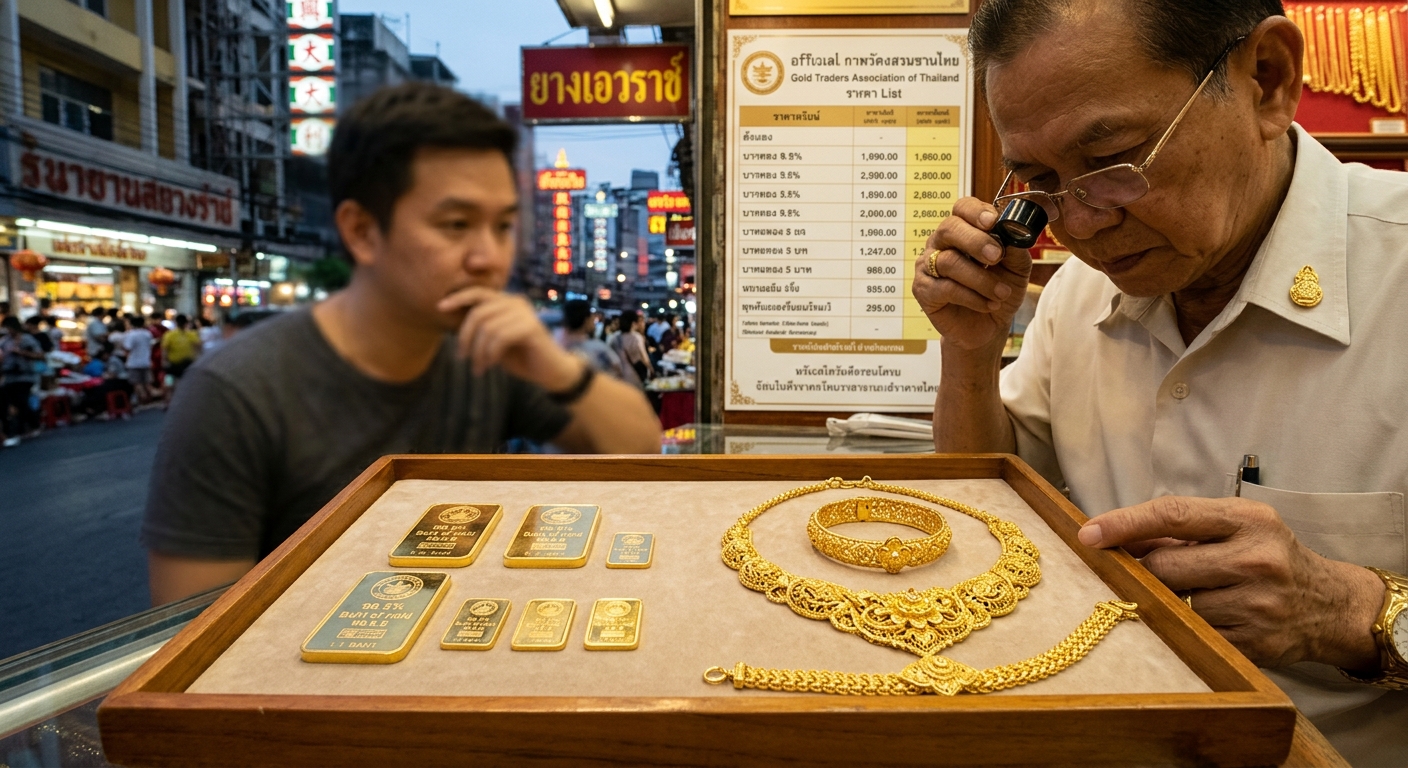
Thailand’s gold market is a fascinating part of Southeast Asia’s financial landscape. For Thai society, this precious metal is not merely a financial asset or an aesthetic ornament; it is a deeply rooted cultural tradition, a family store of value, and a direct symbol of prosperity. It is no coincidence that when walking through iconic neighborhoods like Yaowarat, Bangkok’s famous Chinatown, the streets feature dozens of jewelry shops with window displays filled with pieces of this precious metal.
However, for foreign investors or travelers looking to diversify their wealth, navigating this exotic market can feel like a minefield of misconceptions. A lack of precise information, combined with widespread internet myths, often leads to unfavorable financial decisions.
Buying gold in Thailand can be a viable way to diversify wealth when you fully understand its specific characteristics. Understanding market structure, identifying accredited trading areas, and evaluating manufacturing costs allow investors to operate with the prudence and precision needed to safeguard their capital. Below, we explore the most common myths about buying gold in Thailand.
Thai gold is 24 karats and identical to the Western standard
While traditional Thai gold is 96.5% pure (equivalent to 23 karats), it does not strictly conform to the international standard for global investment bullion, which is 99.9% pure (24 karats). In Thailand, the standard unit of measurement is the gold Baht, which equals 15.24 grams for jewelry pieces or 15.2 grams for bullion bars.
Because of its specific 96.5% purity and local formats, selling this gold to refineries in Europe or the Americas usually requires recertification, melting, or discounts applied to the market value.
Buying gold in Thailand represents a tax-free bargain
Many people assume they can buy precious metals in Thailand at lower prices than the global market. The reality is that the price of Thai gold is strictly regulated and quoted in real time by the Gold Traders Association of Thailand.
The baseline acquisition value closely tracks international gold prices. The savings margins offered by the Thai market stem from lower labor and manufacturing costs, not a reduction in the metal’s intrinsic value. Furthermore, exporting large volumes requires the corresponding customs declaration.
Every jewelry shop in Bangkok has state supervision
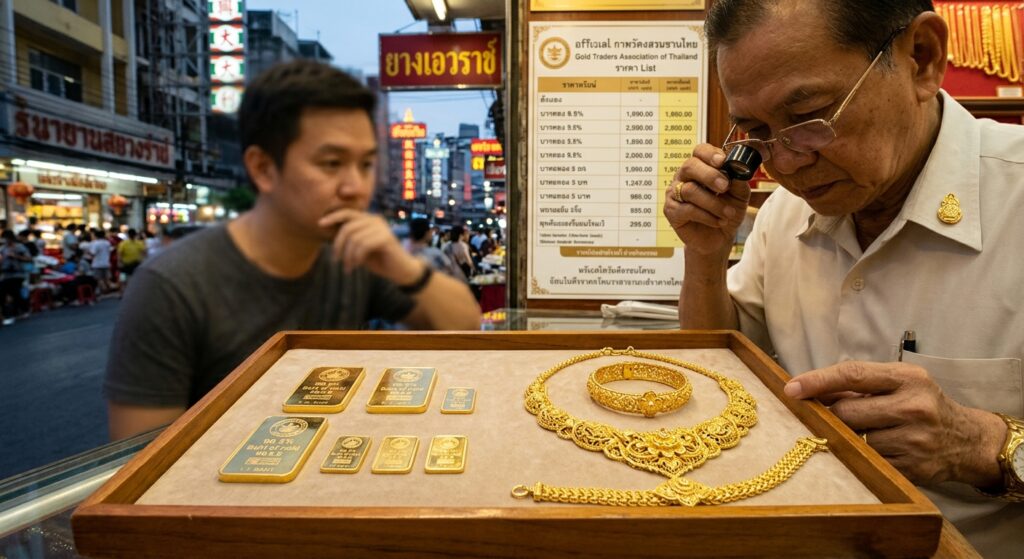
Although the formal sector is structured and traditional establishments in Yaowarat operate with high standards of honesty, the influx of tourists also enables dishonest intermediaries. A recurring practice involves informal guides or local transport drivers redirecting visitors to jewelry shops offering “exclusive discounts.” These shops often offer low-grade alloy pieces, overpriced synthetic gems, or unclear documentation. For this reason, it is recommended to buy only from reliable websites (such as Royal Thai Gold) or physical stores accredited by the Gold Traders Association.
Intricately designed jewelry constitutes the most efficient form of investment
In the Thai gold market, there is a clear distinction between pieces intended for ornamental use and products designed for pure capital preservation. Traditional goldsmith pieces, such as basic chains, cords, or bracelets (collectively known as Thong Baht), carry a minimal manufacturing and labor fee. Conversely, when buyers purchase pieces with intricate carving, artistic inlays, filigree finishes, or high-end Western jewelry influences, the final price includes a significant surcharge for the artisan’s labor and the design’s commercial margin.
Resale dynamics in traditional jewelry stores in Thailand (Mae Thong) are extremely strict and transparent. When repurchasing a piece, the merchant settles the asset almost exclusively on the exact weight of pure gold it contains, applying the official rate set in real time by the Gold Traders Association. This means that the value added by art, aesthetic complexity, or jewelry design is completely lost upon resale. If an investor pays an extra 15% or 20% over the metal’s value solely for complex craftsmanship, they start with an immediate wealth loss that will take years to offset through metal appreciation.
Gold acquired in Thailand retains the same liquidity in any global market
The liquidity of 96.5% pure Thai gold is high within Thailand, where exchange houses and jewelry shops repurchase pieces with very narrow spreads between buying and selling prices. Outside Thailand, bars and jewelry stamped with local refinery hallmarks do not trade directly on organized Western markets (such as the LBMA). Liquidating these pieces in other countries may require laboratory testing, appraisal, and additional refining costs.
Traditional hallmarks guarantee absolute metal authenticity
Although hallmark stamps and marks from recognized jewelry houses offer strong assurance, sophisticated counterfeiting methods still demand caution. Bars or ingots are currently manufactured with dense metal cores such as tungsten, coated with an outer layer of genuine gold.
Visual inspection of a hallmark does not replace volumetric verification or X-ray spectrometry testing. Reputable establishments perform transparent physical tests in front of the buyer; any refusal to verify a piece’s density or purity should be interpreted as a risk signal.
Using cash allows anonymous operations immune to tax regulations
Although Thai retail trade processes significant volumes of cash transactions, the regulatory framework regarding anti-money laundering (AML) and tax control regulations has aligned with international standards. Authorized merchants must identify and record transactions that exceed legal thresholds.
What are your thoughts on this topic? Do you know of any other myth about buying gold in Thailand?
If you are interested in buying Thai gold, you can contact us by visiting the following link.