The market for custom-made Thai gold chains with 96.5% purity (approximately 23 karats) is one of the most sophisticated niches in Asian goldsmithing and precious metal investment. Their combination of exceptional purity, intense yellow hue, and adaptation to the local metric system in Bahts attracts both collectors and international investors.
These gold chains represent an exceptional synthesis between traditional goldsmithing and wealth efficiency. However, due to structural differences between Thai and Western jewelry standards (where 18K or 24K bullion under LBMA rules predominate), numerous misconceptions circulate. These confusions often hinder sound purchasing decisions or lead to costly mistakes when commissioning or liquidating a piece.
Dispelling myths about durability, pricing structure, purity, and liquidity helps buyers make informed decisions and ensures a durable, aesthetically distinctive piece backed by a very high content of pure gold. Below, we analyze and debunk the 7 most common myths about custom 23K Thai gold chains.
23K gold is so soft that custom chains break or deform when worn
Although pure 24-karat gold (99.9%) is indeed extremely malleable and poorly suited for fine everyday links, the standard Thai alloy is strictly formulated at 96.5% purity. That remaining 3.5%, traditionally composed of controlled proportions of silver and copper, provides the mechanical hardness needed to ensure the piece’s structural integrity.
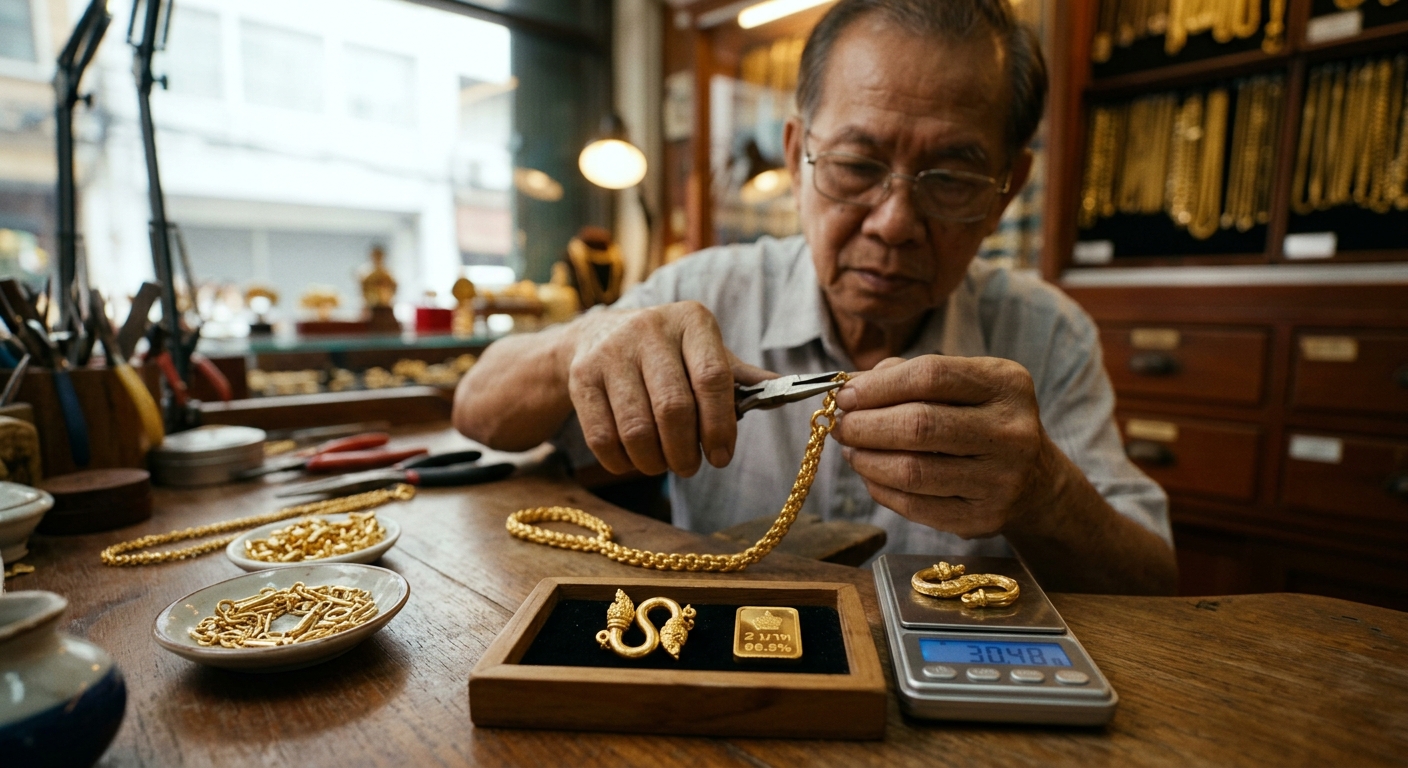
Thai master artisans design link patterns specifically engineered to distribute tension and resist friction. Dense weaves such as the Baht Chain, Dragon Scale, or reinforced anchor link offer outstanding durability. Furthermore, instead of Western clasps with internal steel springs that fail over time, custom 23K chains incorporate traditional manual “S” or “M” shaped clasps, which leverage the metal’s malleability to close securely without external mechanical parts.
Customizing a 23K chain multiplies the price, just like in Western high jewelry
In Western jewelry houses, commissioning a custom piece entails high additional costs associated with branding, exclusive design, and wide commercial markups, often representing more than 50% of the final price. In the Thai market, pricing is governed by strict transparency regulations set by the Gold Traders Association.
The cost of a custom chain is calculated by adding the official quote of the metal weight in Baht (where 1 Baht in jewelry equals exactly 15.24 grams) plus a regulated labor fee called Mong. Although custom or complex designs involve a higher crafting fee than a standard mass-produced chain, this amount still represents a modest fraction compared to the intrinsic value of the gold, allowing the bulk of the capital to remain directly backed by the precious metal.
The intense yellow color of 23K Thai gold is due to a surface plating that wears off
Many buyers accustomed to the pale or greenish-yellow tone of Western 14K (58.3%) or 18K (75.0%) gold mistakenly assume the deep, solar shine of Thai gold comes from an external chemical coating or gold plating.
The intense, warm color of 23K chains is the natural color of gold at nearly total purity (96.5%). Because it is not diluted with 25% or 41% base metals such as nickel, palladium, or zinc, the piece retains its homogeneous hue throughout its entire mass. It requires no surface plating, does not tarnish, and does not change color over the decades; a simple polish or cleaning restores the original brilliance of the solid alloy.
23K Thai gold is illegal or impossible to sell outside Thailand
96.5% gold chains are completely legal assets internationally, provided they comply with relevant customs declarations when exceeding value thresholds established by each country. The confusion lies in differences in secondary-market standardization.
In Thailand and Southeast Asia, liquidity is immediate. Any establishment that is a member of the Gold Traders Association repurchases the chain instantly based on its exact weight and the official daily quote, applying a minimal spread. In the West (the US and Europe), given that these markets operate under the LBMA’s 24K (99.9%) standard or commercial 18K, local jewelry stores are often unfamiliar with the Baht system and 96.5% purity. However, any precious metals refinery, specialized gold-buying house, or international Asian distributor purchases these pieces after verifying their purity via spectrometry and settling them according to their actual fine gold content (96.5% of total weight).
It is not possible to verify the real purity of a custom-made chain without melting it
There is a fear that because a piece is custom-made in a specific workshop rather than a bullion bar minted by a global refinery, verifying its authenticity is impossible without destructive acid tests. Today, accredited jewelry stores and assay offices verify the exact 96.5% purity in seconds using X-ray fluorescence (XRF) spectrometry and gravimetric density tests—completely non-destructive methods that leave no mark whatsoever on the chain. In addition, every reputable Thai workshop stamps its official guild hallmark and purity mark (96.5%) directly onto the “S” or “M” clasp of the custom piece.
Custom 23K chains are only manufactured in excessive, uncomfortable weights for daily wear
This perception stems from iconic images of traditional festivities or ceremonial events in Thailand, where display chains of 5 Bahts (76.20 grams) or 10 Bahts (152.40 grams) are commonly seen for their massive volume and visual presence. However, reducing 23K Thai goldsmithing solely to heavy-gram pieces is a conceptual error. Thanks to the traditional fractional system and custom craftsmanship, it is entirely viable to order lightweight, discreet, and highly ergonomic chains designed for everyday wear under clothing or as a subtle accessory.
The great advantage of commissioning a custom chain at an accredited workshop lies in millimeter-level control over its dimensions and weight in the local metrological system, where the buyer can tailor the order to their budget and physical comfort using standardized fractions:
- 1 Salung (0.25 Baht / 3.81 grams): Represents the lightest and most subtle format, ideal for thin chokers or minimalist chains.
- 2 Salung (0.50 Baht / 7.62 grams): One of the most requested weights for continuous daily wear, offering an optimal balance between discretion, flexibility, and mechanical link strength.
- 1 Baht (15.24 grams) and 2 Bahts (30.48 grams): Constitute the quintessential intermediate range. They allow you to craft chains with notable presence while remaining completely comfortable to wear throughout the entire workday without causing neck fatigue.
- 5 Bahts (76.20 grams) and above: Reserved for those seeking significant accumulation of portable capital or high-display aesthetic pieces.
Unlike industrially mass-produced chains, which are usually limited to standard lengths of 45 cm or 50 cm, customization allows the master goldsmith to distribute the exact agreed weight along the specific length requested by the client (from 42 cm up to 65 cm). Thus, if the buyer wants a long yet lightweight chain, the artisan adjusts the diameter of the 96.5% gold wire and selects hollow link patterns or open weaves that stay light without compromising structural strength. Customization allows the piece to be adapted with mathematical precision to any ergonomic preference and budget.
Any workshop offering custom chains in Bangkok guarantees the 96.5% standard
Although the formal Thai sector enjoys an exceptional reputation for honesty and metrological rigor, high tourist traffic attracts informal intermediaries and unregulated shops outside official circuits. Commissioning a custom chain requires visiting exclusively recognized traditional establishments—such as the large historic houses located in the Yaowarat district—that belong to the Gold Traders Association, publicly display the official daily quote board, weigh the finished piece in front of the client on certified scales, and provide the corresponding certificate of guarantee and itemized invoice detailing weight in grams and Bahts.
What are your thoughts on this topic? Would you like to learn more about custom 23K gold chains?
If you are interested in Thai gold chains, you can contact us by visiting the following link.
Image by MART PRODUCTION via Pexels.com under Creative Commons license.